Unser Kunde im Reifen- und Autoservice verkauft Reifen über Onlineplattformen von verbundenen Unternehmen oder Drittanbietern. Dabei wurden die Daten der getätigten Bestellungen per Mail an unseren Kunden weitergeleitet. Mitarbeitende übertrugen die KundInnen- und Bestelldaten in die eigenen Systeme und stießen notwendigen Folgeprozesse wie die Rechnungserstellung an.
Anschließend wurden relevante Informationen an ein Call-Center unseres Kunden weitergegeben, welches den Kaufenden zwecks Vereinbarung eines Montagetermins telefonisch kontaktierte. Diese Prozesskette war in Summe fehleranfällig, kostenintensiv und beanspruchte häufig mehrere Tage, bis die Produkte an den Kaufenden versandt wurden und eine Terminvereinbarung erfolgte.
Die Lösung von SUSI&James entnimmt und validiert aus der Datenübermittlung alle benötigten Daten, legt die Bestellung vollautomatisch an und erzeugt die zugehörigen Rechnungen. Dieser Prozess verläuft instantan und erfordert kein Eingreifen eines menschlichen Mitarbeitenden. Parallel prüft die KI die Verfügbarkeit und Lieferzeit der bestellten Produkte, gleicht diese mit vorhandenen Werkstattkapazitäten ab und kontaktiert selbstständig den Kaufenden zur Vereinbarung eines Montagetermins.
So konnte die Durchlaufzeit des Prozesses von der Bestellung bis zur Terminvereinbarung von mehreren Tagen auf wenige Minuten reduziert werden. Dies entlastet die Mitarbeitenden unseres Kunden und wird von den Endkunden als innovativer Service empfunden, den die Konkurrenz nicht leisten kann.
Für unseren Kunden aus der Pharmabranche haben wir die Suchfunktion von Medikamenten im Onlineshop verbessert und erweitert. Durch die nun KI-basierte Suchfunktion können KundInnen nun nicht nur nach Produktnamen suchen oder diese vervollständigen, sondern es besteht die Möglichkeit, diverse Kriterien der Suche frei zu verbinden, wie zum Beispiel Hersteller, Darreichungsform, Inhaltsstoffe, Symptome oder auch Unverträglichkeiten.
Durch den Einsatz modernster Verfahren und der Suchoptimierung auf Grafikkarten-basierten Serverarchitekturen konnte die durchschnittliche Antwortzeit der Suchanfragen auf unter 0,1s reduziert werden, obwohl ein Produktkatalog mit mehr als 750.000 Artikel durchsucht wird und die KI auch eingegebene Ungenauigkeiten korrigiert. Dies ermöglicht es Nutzenden in kürzester Zeit das passende Produkt zu finden, ein klarer Wettbewerbsvorteil unseres Kunden gegenüber der Marktkonkurrenz.
Die Technologie ist hoch-skalierbar, auf beliebige Suchen anpassbar und könnte sogar bei einer wesentlich größere Anzahl von Daten in kürzester Zeit erfolgreich Mehrwert stiften.
Unser Kunde bietet individuell auf die Bedürfnisse des Kaufenden angepasste Premiumprodukte an, die in einer komplexen Einzelplatzfertigung größtenteils manuell produziert werden. Dabei mangelte es an Transparenz über den Fertigungsstand und den dann möglichen Auslieferungstermin der einzelnen Produkte. In einem ersten Schritt wurden alle Produktionsschritte digital erfasst, so dass einem Produktions-Dashboard der Fertigstellungsgrad eines jeden Produktes in Echtzeit angezeigt werden kann.
Für jedes Produkt wird ein Fertigstellungstermin prognostiziert, dabei werden Abwesenheiten der Mitarbeitenden oder Materialverfügbarkeiten und weitere Einflussfaktoren berücksichtigt. Unter Nutzung der zur Verfügung stehenden Daten erstellt unser KI-basiertes System eine automatisierte und optimierte Fertigungs- und Auslastungsplanung.
Somit können Ressourcen bei deutlichen geringerem planerischen Aufwand kurzfristig und effizient eingesetzt werden, bei Verringerung der Gesamtdurchlaufzeit in der Fertigung. Dies erzeugt deutlich positive Effekte auf den Wertschöpfungsprozess und wirkt sich positiv auf Mitarbeitenden- und KundInnenzufriedenheit aus.
Das Telefonaufkommen in Rechtsanwaltskanzleien überschreitet die Verfügbarkeit der Mitarbeitenden im Sekretariat. Eine besondere Herausforderung besteht darin, dass das Telefonaufkommen zyklischen Schwankungen unterliegt. In Spitzenzeiten bleiben somit viele Anrufe unbeantwortet. Ohne die Digitale Mitarbeiterin SUSI mussten Sekretariate das Anliegen der Anrufenden in zeitintensiven Gesprächen aufnehmen und stichpunktartig an die entsprechende Rechtsvertretung zur Bearbeitung weiterleiten.
Seit dem Start der Zusammenarbeit unterstützt SUSI Mitarbeitende des Sekretariats. Sie übernimmt alle Anrufe, welche vom Team des Sekretariats nicht bearbeitet werden können. Im Gespräch nennt der Anrufende den Grund des Anrufs und die KI klassifiziert das Anliegen. In Abhängigkeit des erkannten Themas stellt SUSI gezielte Rückfragen, oder beantwortet die Frage des Anrufenden sofort.
Anschließend sendet sie eine Zusammenfassung inklusive abgefragten Aktenzeichen an die entsprechende Abteilung oder direkt an die betroffene Rechtsvertretung. SUSI informiert zudem den Anrufenden, welche Dokumente bereits im Vorfeld an die Kanzlei gesendet werden können. Dies reduziert die Zahl der Rückrufe und minimiert die Durchlaufzeit.
Das Energieversorgungsgeschäft ist stark von saisonalen Ereignissen geprägt. Preiserhöhungen, Rechnungsversand oder neue Energiepauschalen sorgen dafür, dass viele KundInnen in einem sehr kurzen Zeitraum Kontakt zum Energieversorgungsunternehmen aufnehmen. Das eingehende Telefonaufkommen ist in Zeiten von Fachkräftemangel und der ohnehin schon enormen Arbeitslast nicht immer abzufangen.
Die Digitale Mitarbeiterin SUSI bringt im Rahmen des SmartOffice die nötigen Skills und Erfahrungen mit, um Energieversorgungsunternehmen und andere öffentliche Betriebe direkt zu unterstützen. Sie übernimmt den gesamten Anrufüberlauf und kümmert sich um eine vom Anliegen abhängige Weiterleitung. Bei kritischen Anliegen, wie einer Gasstörung, leitet sie das Gespräch direkt telefonisch an die Störmeldezentrale weiter.
Durch die fallabschließende Verarbeitung von Zählerständen, Abschlagsanpassungen oder Rechnungsänderungen gewinnen die Mitarbeitenden Zeit, welche sie in die betreuungsintensiveren Gespräche mit KundInnen investieren können.
Unternehmen aus dem Hotel- und Gastgewerbe sehen sich oft mit denselben Problemen konfrontiert: angespannte Personalsituation, Fachkräftemangel und viele telefonische Anfragen an das Serviceteam. An dieser Stelle unterstützt unser SmartOffice von der Gästebetreuung bis hin zur fallabschließenden Bearbeitung. Die Angestellten des Hotels werden durch eine Übernahme der Telefongespräche durch unsere KI entlastet und können sich durch das SmartOffice 2.0 nun intensiver den Gästen im Haus widmen.
Unsere Technologie klassifiziert die aufgenommenen Anliegen der Anrufenden und stellt diese den richtigen Teammitgliedern zur Verfügung. Dadurch ist – falls nötig – ein schneller und kompetenter Rückruf möglich.
The artificial intelligence-based digital employee SUSI from SUSI & James GmbH takes over and optimizes a wide variety of communication-heavy business processes in companies. SUSI ensures 24/7 that no call goes unanswered and takes all calls. With its support, SUSI creates space and time for service-intensive issues. Employees can once again concentrate fully on value-adding activities.
In this article, we highlight the use of SUSI as a Digital Product Advisor.
We show how to combine traditional NLP with the power of LLMs and Generative AI in a way that ensures the best possible customer experience.
The following demo is about a consultation between a digital employee and a user who is interested in buying a new car. SUSI guides the user through a three-step process in which general information about the desired vehicle can first be provided. Then, based on a suggested selection of eligible vehicles, the user can learn more about these vehicles by asking specific questions. Once the user has decided on one or more vehicles, the last step is to arrange a test drive or a purchase appointment.
Step 0 — Preparing the data and make some basic considerations
The basis for product consulting are products, in this case about 7000 current vehicles, which are available in JSON format. (Displayed simplified in this example){ „name“: „A3“, „car_model_id“: 82, „car_trim_id“: 25295, „car_series_id“: 2901, „car_production_year“: „2016“, „car_series_name“: „Sportback Schrägheck 5-Tür“, „car_trim_name“: „1.2 TFSI MT (105 ps)“, „car_specifications“: { „Anzahl der Gänge“: „6“, „Schadstoffeinstufung“: „EURO V“, „Fahrzeugart“: „Schrägheck“, „Sitzplätze“: „5“, „Breite“: „1785“, „Radstand“: „2636“, „Spur vorne“: „1535“, „Kofferraumvolumen minimal“: „380“, „Kofferraumvolumen maximal“: „380“, „Spur hinten“: „1506“, „Kraftstoffe“: „Benzin“, „Hubraum“: „1197“, „Wendekreisdurchmesser“: „10.9“, „Zuladung“: „485“, „Anhängelast (gebremst)“: „3240“, „Ladehöhe“: „677“ }, „car_options“: { „Attraction“: [ „Elektromechanische Servolenkung mit variabler Kraft auf das lenkrad“, „Servotronic (aktives lenkrad)“, „Schallschutz Verglasungen“, „Start-stop-System“, „Mechanische Vordersitze einstellen“, ], „Ambiente“: […], „Ambition“: […] }, „manufacturer“: „Audi“ }
When developing a Retrieval or Retrieval Augmented Generation (RAG) approach for a dataset containing detailed car (or any other product) information, it’s crucial to consider various factors to ensure an effective and accurate system. Here’s a breakdown of the aspects to consider:
Understanding the Data Structure
Understanding the dataset’s structure is foundational. The given dataset is in a structured format with nested fields and especially mixed data types, which requires a clear understanding to accurately retrieve or generate the necessary information. Special consideration should be given to the fact that, depending on the heterogeneity of the data points, aspects such as the presence of contextual information,digits, and mixed data must be taken into account, especially when vectorizing.
Indexing Strategy
Proper indexing is crucial for effective retrieval. Consider using a robust indexing strategy to ensure quick and accurate retrieval of car details based on various parameters such as car model, production year, or manufacturer.
Query Formulation
The query formulation should be designed to handle a variety of search terms and parameters. It should be robust enough to accommodate different types of queries and return relevant results.
Retrieval-Augmented Generation
For RAG, integrating retrieval mechanisms with generation models requires a seamless flow of information. Ensure that the retrieval process can feed relevant data to the generation model to facilitate meaningful output. Special attention should also be paid here to the question of the target language, since capable LLMs do not function well multilingually in every case.
Evaluation Metrics
Establishing evaluation metrics is necessary to measure the performance of the retrieval and generation systems. Metrics could include accuracy, recall, precision, and F1 score among others. To perform a qualitative analysis of the entire scope, individual metrics are usually inadequate. Frameworks like Ragas can fill this gap.
Scalability
The system should be designed to handle scalability to accommodate growing data or increased query loads without compromising performance.
The Haystack framework and the SmartOffice form the basis for the above steps. In the example shown, it quickly becomes clear that an initial selection of vehicles to be proposed can and should be based on a number of metadata such as manufacturer, fuel consumption and number of seats.
Since a classic document is represented in Haystack as follows:class Document: content: Union[str, pd.DataFrame] content_type: Literal[„text“, „table“, „image“] id: str meta: Dict[str, Any] score: Optional[float] = None embedding: Optional[np.ndarray] = None id_hash_keys: Optional[List[str]] = None
the question quickly arises as to which JSON content is defined as content on which textual embeddings will later also be generated and which data will become part of the meta-data.
As for the choice of database (or DocumentStore), we compared Weaviate and ElasticSearch. Both systems offer similar advantages and disadvantages, especially the advanced filter logic in the case of ElasticSearch tipped the scales for prototyping.
Step 1 — Designing Prompts for Basic Retrieval
In this step, the focus is on the question of how to derive and extract from almost arbitrary natural language statements the criteria on which meaningful filtering can be performed.
Step 1: General description of the car and its parameters
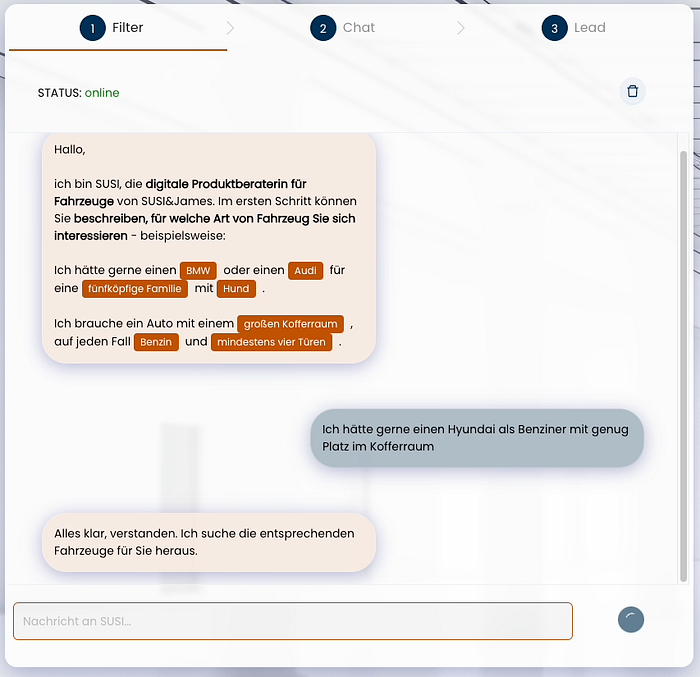
The statement pictured in SUSI’s introduction translates as:
„I’d like a BMW or an Audi for a family of five with a dog.“
The filter we need to construct from this in Haystack-compatible format looks like this:{ „$and“: { „number_of_seats“: { „$eq“: 5 }, „trunk_volume_minimum“: { „$gte“: 400 }, „manufacturer“: { „$in“: [ „BMW“, „Audi“ ] } } }
For this problem, we evaluated several approaches, including:
Text2SQL approach which refers to a type of natural language processing (NLP) approach that translates natural language queries into SQL (Structured Query Language) queries.
Span extraction approach which refers to a task in Natural Language Processing (NLP) where the goal is to identify and extract a specific portion of text, referred to as a “span,” from a larger body of text based on a given query or condition.
Generative approach which refers to the assumption that large language models given a specifying prompt have sufficient knowledge about identifying and extracting specific information from a given text to be able to satisfy the aforementioned requirement in the form of generated output.
After a short prototyping phase of the mentioned approaches, we decided to use the generative approach. The shortlisted models were:
After a prompt engineering phase, the following prompt proved to be a good fit (partially shown here):I need you to create a json serialized python dictionary as string that is derived from a user input.
In the user input there are filter criteria that can be expressed in different ways. The user can express himself on the following parameters:
The following logical operators are available: $and, $or
The following comparison operators are available: $eq, $in, $gt, $gte, $lt, $lte
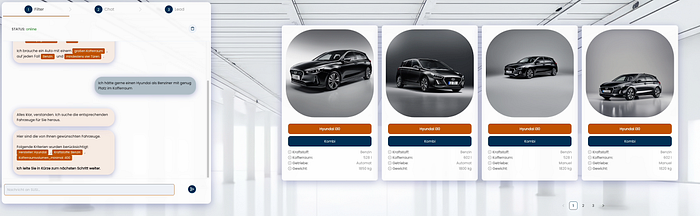
The GPT-4 and Falcon-180B models have shown similar performance quality, which is why we have implemented both methods in a configurable way. The outcome looks like:
Step 1: Result with eligible cars bases on the user input
It should be mentioned that the biggest challenge was to get the models to reliably produce structured output in JSON format. In the meantime, there are various approaches to this problem, which we have not dealt with further in the scope of this processing. It should also be mentioned that while the LeoLM model did not quite provide the required result in this case, it has proven to be very capable in other experiments, such as extracting personal data from a text.
Step 2 — Designing Prompts for Advanced Retrieval and Question Answering
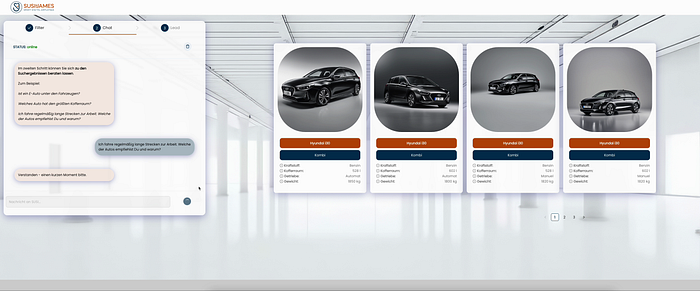
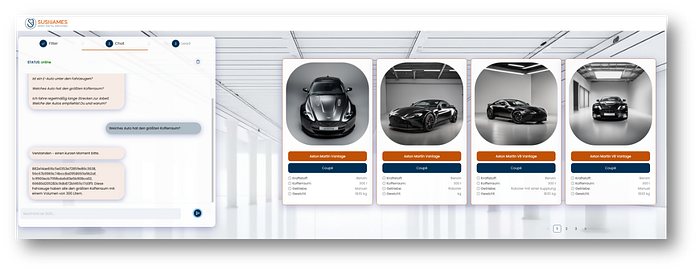
In this step, the focus is on a consultation regarding the pictured vehicles (and also additional ones not pictured). The user should intuitively and colloquially ask questions or discuss ideas that will help him/her select specific vehicles.
Step 2: Consultation regarding the pictured vehicles
The statement pictured in SUSI’s introduction translates as:
“I regularly drive long distances to work. Which of the cars do you recommend and why?”
In this statement, representative of the presented form of expected user input, there are several challenges at once.
As already visible in Step 1, there is no parameter in the data basis that reads: “suitable_for_long_distances”. Even if there were, the question of qualification to this suitability would arise. The user’s expectation is different: “I don’t know exactly what parameters need to be considered to make a vehicle suitable for long trips, so I hope (or expect) that YOU know.”
In the second part of the statement, the user unconsciously (sometimes consciously) provides the context of the vehicles to be considered by using the term “of the (mentioned) cars”. At this point, we use the demonstrable power of the RAG procedures, in two ways:
We instantiate an agent that handles the communication with the user. The advantage of the agent is a persistent memory, which is made available as a previous conversation history to the processing of the user input. Thus, the model is aware of the context when referring to information in the previous conversation by the user.
We then give the agent various tools such as retrieving data from the Elastic Cluster and checking information on the Internet, and of course the basis of judgment: the vehicles and their data, and then try to let the model capture the relationship between the user input and the data at hand by clever prompting:Below you will find information about vehicles, such as their length, weight and equipment. Each vehicle has its own line and each line begins with the vehicle id. The information has the scheme „attribute_descriptor: attribute_value;“ except for the options. These are under „Optionen“ and are listed as packages with the schema „_package_descriptor_: list_of_comma_separated_attributes“. {car_description} Under the vehicle information you will find the question of a user. Answer the question as best you can, based solely on the vehicle information. Write the answer in German. If you can’t find the answer based on the information, please let us know. Every answer should have the format: „vehicle_id (or vehicle_ids comma separated): textual_response“, except if the user expresses an interest in buying or test driving the product, you will output „%smartoffice#vehicle_id or comma separated vehicle_ids#kind_of_interest%“ (where kind_of_interest is either test_drive or buy_vehicle) as the response. It is possible that the user asks questions or statements with a reference to the previous course of the conversation, which you can find here: {history} Your answers should take this conversation history into account, if appropriate and necessary. Question: {query} Response:
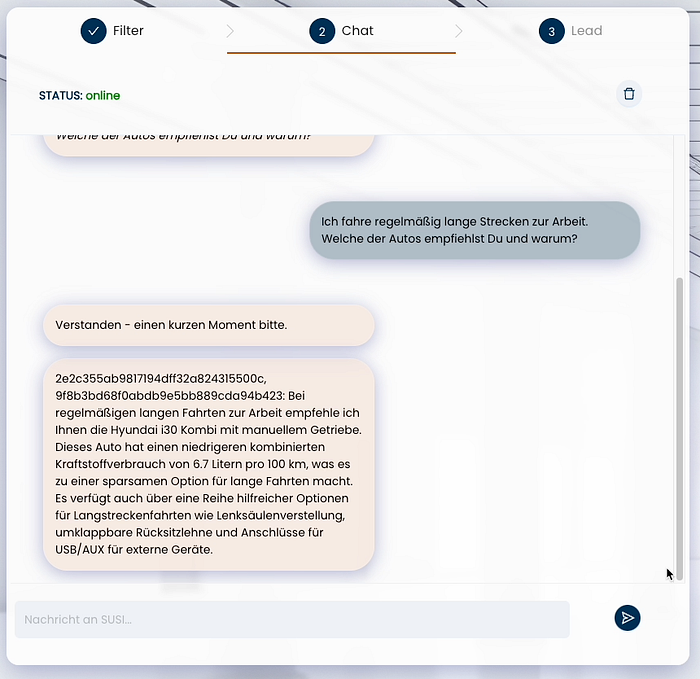
Step 2: Response from the RAG approach
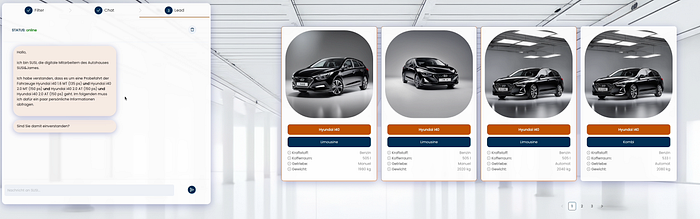
The response in the image translates to:
“For regular long trips to work, I recommend the Hyundai i30 station wagon with manual transmission. This car has a low combined fuel consumption of 6.7 liters per 100km, which makes it an economical option for long trips. It also has a number of helpful options for long distance driving such as steering column adjustment, folding rear seat back and ports for USB/Aux for external devices.”
This is exactly the behavior that we hope for or imagine from our digital employees. The response not only addresses the focus of the user’s input, but also provides additional information that is considered helpful to the user.
This time the result was more difficult to judge. While GPT-4 stood out positively in terms of “consulting performance”, the interpretation of user input in terms of “parameters to be taken into account” or the direct answering of questions was clearly better in Falcon-180B from our point of view.
Step 2: Follow up questions to a given set of cars
The difficulty was, and still is, primarily in correctly capturing the task that is generated from the interpretation of the user input and letting it flow into the prompt.
The question and the response in the image translate to:
Q: “Which of the vehicles has the largest trunk?”
A: “These vehicles have the largest trunk with a volume of 300 liters.”
Similar to the example just given, there is an implicit reference to the vehicles defined as the result set in the previous step. The character of the user’s question is reminiscent of a classic example of automated question answering. The complexity of the question is much lower than the previous one because of the level of inference we expect from the model in terms of deliberative conversation.
Step 3 — Handing over to the SmartOffice
At this step, the user has gone through the process to the point where there is either an interest in purchasing or an interest in test driving one of the vehicles. At this point, one could rightly think about the further use of an agent-based solution, but in the corporate context we rely on our SmartOffice product, as it already solves a large part of the existing challenges in a sensible and efficient way.
Step 3: Handover of the user to the guided dialog
The introduction in the image translates to:
“Hello,
I am SUSI, the digital employee of SUSI&james car dealership. I understand that this is about a test drive of the vehicles “Huyndai i40 1.6 MT (135HP)”. In the following I need to ask some personal information for this.
Do you agree with this?”
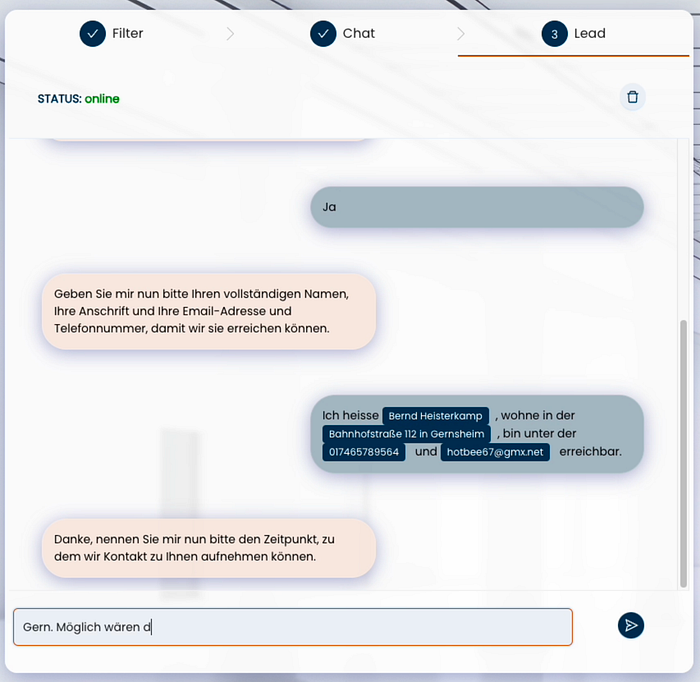
The conversation then continues as follows:
Step 3: Continuous processing through the SmartOffice
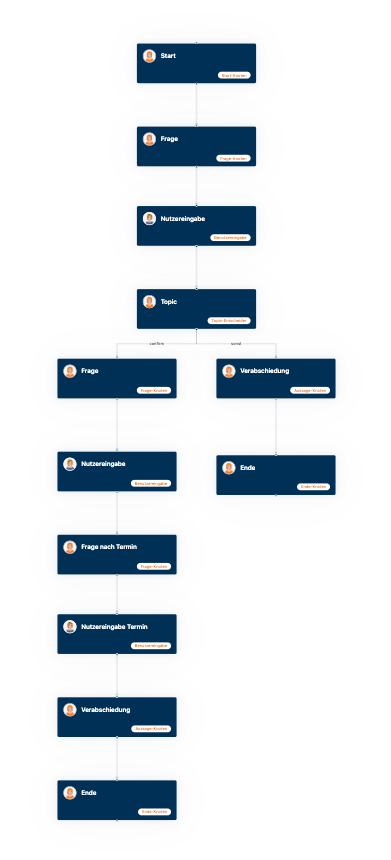
SUSI in SmartOffice needs to collect various information to make an appointment for a test drive. This information is requested in the course of the conversation, and queries are asked if necessary. In this case, this is not not done by an “autonomous” agent, but around the NLU core of the SmartOffice, orchestrated by predefined dialogs, as shown in the following image:
Step 3: A dialog created with the DialogBuilder of SmartOffice
SmartOffice processes all the information obtained during the call and can subsequently provide it for further processing in various ways, e.g. in the form of an API call, a mail or an outgoing call.
The path shows how a consultation with predefined interest can turn into a potent lead in a sales pipeline. For reasons of comprehensibility, the procedure shown is divided into several steps. It is of course also conceivable (and we have also evaluated this) to greatly simplify this process.
Learnings
In our view, the topic of product advice is challenging even in the very current technology space with Question Answering, Retrieval Augmented Generation, Autonomous Agents and Conversational AI. The main reason for this is certainly that we are not dealing with classic, general conversations with a simple question-answer process, but with complex, multi-layered dialog logic.
The following striking features and learnings are worth mentioning at this point:
Modular architecture based on LLM
When designing the product consultation, we wanted to take into account that the product base may change. In one case it might be vehicles, in the next it could be medicines or beauty products. For this reason, all components that are use-case specific are designed as modules (the database, the prompts, …), so that an exchange and an adaptation are possible intuitively and with little time effort.
LLM vs “traditional approaches”
In the steps shown, it was obvious not to commit to a single technology approach, but to decide in a fine-grained way which solution path is suitable for which problem. While “traditional” approaches such as entity extraction and possibly even syntax parsing promise a certain degree of security through reproducibility and control, they are relatively costly — for example, due to the use-case specific adaptations. Using Large Language Models, on the other hand, works intuitively even in the first approach, and if you have either the hardware or the necessary financial resources, you will have qualitative results very quickly. In fact, one should not make the mistake of considering the topic of “prompt engineering” as “solved”. Even minor changes decide the value of the output and should be well considered. In addition, the currently popular question arises in any case whether one should finetune an LLM in relation to the usecase or whether one should choose a RAG approach, for example. Here, too, requirements such as a clean data basis, training resources and time quickly pose a hurdle.
Unpredictability of user input
During the testing of the system shown and also of SmartOffice in general, we noticed that we often only think we know what the concerns of users are and that we can only assume what inputs in system landscapes look like. For this reason, we follow the CDD (Conversation-Driven Development) approach here as well:
“Conversation-Driven Development (CDD) is the process of listening to your users and using those insights to improve your AI assistant. It is the overarching best practice approach for chatbot development. Developing great AI assistants is challenging because users will always say something you didn’t anticipate. The principle behind CDD is that in every conversation users are telling you-in their own words-exactly what they want. By practicing CDD at every stage of bot development, you orient your assistant towards real user language and behavior.”
Through the evaluation of the system, we are certain: LLMs can play out their advantages here in particular. Due to the extensive language base, they are able to deal with unforeseen events in a much more target-oriented way than rule-based approaches in the worst case. This case should also be controlled, but gains a certain degree of autonomy.
Added value of consulting services
Utilizing LLM-based AI in consulting for product advisory not only enhances the quality and breadth of services but also can lead to more innovative, timely, and cost-effective solutions for clients. However, it’s important to note that the human touch, ethical considerations, and deep contextual understanding that human consultants provide remain irreplaceable, and the LLMs could be seen as complementary tools rather than full replacements. Nevertheless here are a few advantages:
24/7 Availability
Unlike human consultants, LLMs can provide advisory services round the clock, enhancing the accessibility and convenience for clients across different time zones.
Scalability
LLM based AI can scale to handle a larger volume of queries or a growing client base without a proportional increase in operational costs.
Continuous Learning
With the right setup, LLMs can continuously learn from new data and feedback, improving the accuracy and relevance of the advice over time.
Improved Decision Support
The data-driven insights generated by LLMs can provide robust decision support to clients, aiding in risk assessment and strategic planning.
Thank you for the attention and time invested. If you want to learn more about the use case and its uses, the demo itself or the underlying technology, get in touch anytime via mail or LinkedIn.
Gemeinsam mit der Universität Stuttgart und dem Fraunhofer Institut entwickeln wir sprachbasierte Human-Machine-Interfaces, mit welchen Nutzer- und Kontextinformationen während der Fahrt erfasst werden. Mittels unserer Technologie unterstützt unsere Sprachassistentin den Researcher im Auto und interagiert mit den Fahrenden. In einem weiteren Schritt wird das KI-System in der Emotionserkennung zum Einsatz kommen. Diese Fähigkeit verbessert die User-Experience im Fahrzeug perspektivisch stark.
Mit NLU können Daten analysiert und ihre Bedeutung durch Algorithmen bestimmt werden, indem die menschliche Sprache in eine strukturierte Ontologie reduziert wird – ein Datenmodell, das aus semantischen und pragmatischen Definitionen besteht. Die beiden Grundkonzepte von NLU sind Absichts- und Entitätserkennung.